What Drives AI Citations? Content, Retrieval and Model Knowledge in Generative Engine Optimization (GEO) was submitted to arXiv on 2026-10-10 by Mahe Chen, Nick Koudas. Read it on arXiv or as a PDF.
Why it matters for getting cited
- In two 90-day collections covering 158,099 answers and 468,037 citations, common additions such as FAQ blocks, structured data, and summary boxes show no benefit when comparing pages on the same website.
- Content helps primarily when page titles and paragraphs match the specific questions people ask.
- Retrieval explains 32% of citation variation between pages of a website, whereas page properties explain only 2.8%.
- Generative engines rewrite user questions into their own sub-queries, producing retrieved search results that rarely overlap with standard Google or Bing results.
- Large language models introduce their own internal knowledge into citations by writing known brand names into queries and naming brands without citing any source page.
The main takeaway. AI citations depend primarily on whether an engine’s internal retrieval retrieves a page, rather than on technical page markup. Publishers earn citations by matching user questions in meaning and establishing brand familiarity within the model.
The abstract, as written
Generative search engines such as ChatGPT, Gemini and Perplexity now decide which Web pages users see as sources, and a growing industry of generative engine optimization advises publishers on how to earn these citations. We study what shapes citation in two 90-day collections of answers to commercial questions in contrasting markets: 158,099 answers with 468,037 citations. Comparing pages of the same website, content matters in one way: pages whose title and paragraphs match the questions people ask are cited more, whereas FAQ blocks, structured data, summary boxes and page speed appear effective only across websites. Page properties nevertheless explain little of the variation between pages of a website. Replaying the questions through the engines’ APIs shows why. Every page ChatGPT cites is one its own search retrieved, and which pages that search retrieves, for sub-queries the model rewrites on every answer and that rarely coincide with Google’s or Bing’s results, explains far more of the variation than page properties (32% against 2.8%). Content acts mainly through this step, by matching the engine’s queries in meaning. The model’s own knowledge shapes it too: ChatGPT writes brands it knows into its searches, prefers websites it knows, and names brands without any supporting page, and controlled experiments show that brand names reorder its rankings of products with identical facts. Pages are thus cited when searched; brands are also named when remembered. The findings replicate in a market of small B2B vendors. We release data and code.
Key terms
- Generative Engine Optimization: The practice of modifying web pages to increase their visibility and citations inside AI generated search answers.
- Retrieval-Augmented Generation: An architecture where a language model queries an external retrieval system to find documents before generating an answer.
- Within-Website Comparison: An evaluation method that compares pages from the same site to control for domain-level authority and reputation.
- Model Prior: The background knowledge and biases stored in the parameters of a language model before it retrieves external documents.
- Sub-Query Rewriting: The process by which a generative engine transforms a user prompt into distinct search queries to retrieve web documents.
From the paper
Comparing pages within the same domain shows that popular technical formatting practices provide no measurable boost.
Comparing pages of the same website, content matters in one way: pages whose title and paragraphs match the questions people ask are cited more, whereas FAQ blocks, structured data, summary boxes and page speed appear effective only across websites.
API replaying confirms that citation selection is driven by the engine’s internal retrieval rather than on-page factors.
Every page ChatGPT cites is one its own search retrieved, and which pages that search retrieves, for sub-queries the model rewrites on every answer and that rarely coincide with Google’s or Bing’s results, explains far more of the variation than page properties (32% against 2.8%).
Generative search engines obscure citation dynamics behind opaque retrieval pipelines and parametric model memory.
As generative engines become a gateway to the Web, which pages and brands are visible depends on retrieval and model knowledge that publishers cannot observe and that change from week to week.
Figures from the paper
The dot plot illustrates how the apparent citation gains of common optimization tactics disappear when comparing pages within the same website.
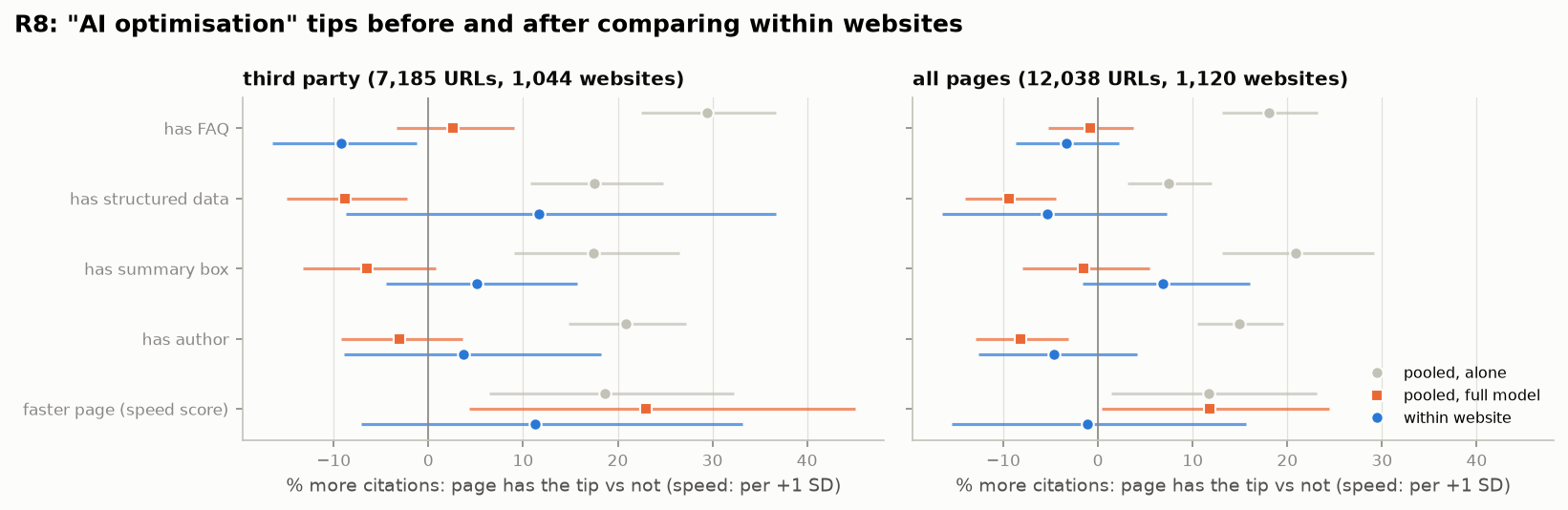
Figure from the paper, arXiv:2610.15033, by its authors. Caption as written: Figure 1. Effect of recommended practices on citations: across all pages with the practice alone (grey), across all pages with all other features (orange), and comparing pages of the same website (blue), with 95% intervals. Left: third-party pages; right: all pages. Dot plot of the estimated effect of FAQ blocks, structured data, summary boxes, author boxes and page speed under three comparisons; the effects shrink to near zero within websites.
What the authors say it means
- Optimization advice focusing on structural widgets such as FAQ sections or schema tags provides little standalone benefit within a domain.
- Achieving citations requires appearing in the specialized retrieval step run by the engine, which uses internal query rewrites distinct from conventional search engines.
- Language models rely partly on parametric memory when choosing what to cite, giving well-known entities an inherent citation advantage.
- Tracking visibility in generative engines requires continuous observation because citations and query rewrites shift over time.
What to do with it
- Align page titles and opening paragraphs directly with user questions. Supported by: In the abstract, matching user questions in page titles and paragraphs is the single content feature that increases citations within the same website.
- Focus on topical semantic relevance rather than surface formatting like FAQ blocks or summary boxes. Supported by: The abstract finds that FAQ blocks, structured data, and summary boxes show effectiveness only across websites rather than within them.
- Target the underlying retrieval step rather than relying solely on conventional search rankings. Supported by: The abstract reports that retrieval explains 32% of citation variation while page properties explain only 2.8%.
- Build brand presence across the broader web to influence model memory. Supported by: The abstract notes that models write known brands directly into internal search queries and cite known websites preferentially.
Caveat. The study observes correlations across commercial queries in two markets and does not prove that changing a specific page will alter its citation rate. The authors did not run live interventions on model training or publisher websites.
In short
Generative search engines select citations through their own internal search queries and existing model knowledge. Standard formatting tricks fail to increase citations when comparing pages from the same site. Visibility requires matching user queries closely in meaning and building recognition within the model.
Written from the paper's own text and checked by a person before publishing. Quoted passages are verbatim; numbers are the authors' own. For the method and full results, read the paper.