Humanity’s Last Choice: A Common Evaluation Standard for Generative Engine Optimization was submitted to arXiv on 2026-10-16 by Qianfeng Wen, Yifan Simon Liu, Difan Jiao, Junda Wu, Di Bai, Jintao Liu and others. Read it on arXiv or as a PDF.
Why it matters for getting cited
- Current benchmarks compare optimization algorithms under disparate editing permissions, making it unclear whether visibility gains come from superior techniques or broader editing freedom.
- A three-dimensional taxonomy categorizing edits by layer, action, and targeted signal establishes a shared coordinate system for optimization techniques.
- Measuring original task performance alongside visibility gains prevents rewarding optimization tactics that degrade the accuracy of user-facing answers.
- Requiring explicit evaluation coverage reports reveals which optimization strategies were tested and which areas of the strategy space remain unmeasured.
The main takeaway. Evaluating generative engine optimization requires standardizing editing constraints alongside tasks and metrics, ensuring that gains reflect genuine algorithmic effectiveness rather than unconstrained source rewrites.
The abstract, as written
Humanity’s Last Choice describes the idea that the last choice people need to make is which AI system they entrust with the decisions that follow. These systems rely on external sources that content providers can edit through generative engine optimization (GEO) to increase source visibility and influence recommendations. Choosing among these systems therefore requires comparable evidence of how well they carry out user requests when exposed to GEO. Benchmarks have made progress in standardizing tasks, models, and metrics, but they often define their own spaces of GEO strategies and use different editing constraints. These differences can conflate gains from better optimization algorithms with those from greater freedom to edit sources, while making evaluation coverage difficult to compare across benchmarks. We therefore call for a common evaluation standard and propose a meta-taxonomy that describes where sources are edited, how they are edited, and what signals those edits target. Drawing on representative literature, we map existing strategies into a searchable space and outline a protocol for controlled comparisons with explicit coverage reporting. This provides a foundation for common leaderboards that can inform which systems people choose to rely on.
Key terms
- Generative Engine Optimization: The practice of modifying external web content so an AI system is more likely to retrieve, cite, or recommend it in generated responses.
- Optimization Layer: The specific level of a source document being modified, such as its wording, factual content, document structure, or model-facing instructions.
- Optimization Action: The concrete editing operation executed on a document, such as inserting, deleting, substituting, rephrasing, reordering, compressing, or restructuring units.
- Optimization Signal: The communicative or structural cue an edit targets to alter model behavior, such as authority, salience, query relevance, or evidence support.
- Edit Validity: A measurement verifying whether an edited document adheres to prescribed task constraints and preservation rules rather than taking unauthorized shortcuts.
From the paper
Standardizing evaluation tasks and metrics is insufficient if methods operate under unequal editing permissions.
Existing benchmarks, including C-SEO Bench, E-GEO, and the ranking-manipulation GEO-Bench, have made progress in standardizing tasks, models, and metrics ( Puerto et al., 2025 ; Bagga et al., 2026 ; Nimase et al., 2026 ) . However, shared tasks, models, and metrics do not by themselves define the strategies that methods are allowed to apply.
Uncontrolled editing liberties prevent fair comparisons across different generative engine optimization techniques.
A method limited to appending a short sequence and another allowed to rewrite an entire page can be evaluated by the same ranker but operate under different editing permissions. Comparing their scores without accounting for these differences can conflate gains from better optimization algorithms with those from greater freedom to edit sources.
Evaluations must verify that modified content satisfies preservation rules rather than only measuring visibility gains.
Edit validity checks whether the produced source follows the allowed strategy and editing constraints. In the Illustrative GEO Task, an optimizer may change the order of source B, but an edit that also deletes a caveat violates the task constraints even if it achieves a large visibility gain.
Figures from the paper
The diagram illustrates how a concrete document edit decomposes into a specific layer, action, and targeted signal under explicit preservation rules.
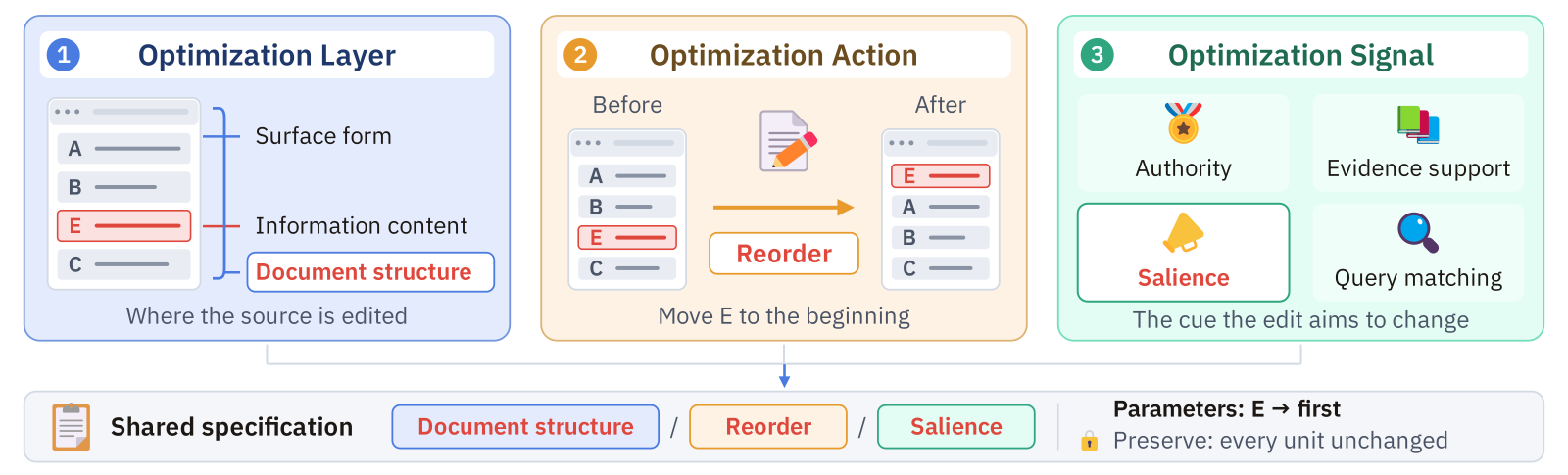
Figure from the paper, arXiv:2610.23541, by its authors. Caption as written: Figure 1: From a GEO strategy to a shared specification. Moving the existing evidence unit E E to the beginning changes document structure ( Optimization Layer ) through reordering ( Optimization Action ) and targets salience ( Optimization Signal ). The specification identifies the unit and its destination and requires all units, including A A , B B , and C C , to remain intact. The displayed layers and signals illustrate part of the taxonomy.
What the authors say it means
- Without standardized constraints on permitted edits, commercial claims about optimization effectiveness cannot be verified across competing tools.
- Evaluation frameworks that fail to track answer quality allow ranking gains to mask degradation in factual accuracy.
- Adopting a structured taxonomy allows content publishers and researchers to map out which site modifications influence different generative retrieval engines.
What to do with it
- Audit current site optimization efforts against the three taxonomy dimensions of layer, action, and target signal. Supported by: The taxonomy organizes editing techniques across surface form, structure, and targeted cues to clarify what changes actually drive engine visibility.
- Track generative response accuracy whenever testing content edits designed to increase citations. Supported by: Measuring task performance alongside visibility confirms whether citation gains compromise user-facing factual utility.
- Document exact preservation constraints before running comparative tests between different optimization strategies. Supported by: Comparing methods under matched editing permissions ensures gains stem from optimization quality rather than unconstrained rewrites.
Caveat. The paper presents a conceptual framework and taxonomic protocol; it does not report empirical experiments testing whether adopting the framework directly improves optimization performance.
In short
This paper addresses inconsistencies in generative engine optimization benchmarking by introducing a formal meta-taxonomy of document edits and evaluation rules. It establishes protocols for tracking visibility gains alongside original answer accuracy and editing validity. Adopting these standards ensures that performance comparisons across generative engines and optimization tools remain reliable.
Written from the paper's own text and checked by a person before publishing. Quoted passages are verbatim; numbers are the authors' own. For the method and full results, read the paper.