Conversational Capture: A Trajectory-Level Framework for Evaluating Generative Engine Optimization in Multi-turn Human-Agent Interaction was submitted to arXiv on 2026-09-30 by Junwei Yu, Jieyu Zhou, Mufeng Yang, Yepeng Ding, Hiroyuki Sato. Read it on arXiv or as a PDF.
Why it matters for getting cited
- Traditional single-turn Generative Engine Optimization metrics assume independent turns and treat the feedback term as zero, ignoring how earlier answers steer subsequent retrieval.
- In conversational interaction, citations compound across turns so that the compounding ratio exceeds two within ten turns.
- Single-turn visibility metrics and full multi-turn trajectory rankings show weak agreement with a Kendall correlation of 0.4, meaning single-turn tests can select the wrong optimization tactic.
The main takeaway. Evaluating generative engine optimization on single queries misidentifies effective content tactics because early citations create closed-loop feedback that compounds visibility over an entire dialogue.
The abstract, as written
Generative Engine Optimization (GEO) shapes content to increase its likelihood of being cited by answer engines built on retrieval-augmented large language models. GEO is typically evaluated as a single-turn property: for a fixed query, an evaluator measures a source’s visibility in one answer. We argue that the single answer is an inadequate unit of analysis. Human-agent information seeking forms a closed loop: the agent’s answer changes the user’s beliefs and therefore the next question, which in turn determines what the agent retrieves. We introduce conversational capture, a phenomenon in which a source cited early becomes substantially more likely to be cited again. Capture operates through a machine-side channel, history-conditioned retrieval, and a human-side channel, follow-up questions directed toward the captured source. We formalize the interaction as a two-layer closed-loop system and derive trajectory-level constructs: cumulative conversational visibility; a direct/feedback decomposition of trajectory gain; a nested split of the feedback term into machine-side and human-side channels; a capture coefficient; a compounding ratio; and a misranking diagnostic. Using reinforcement-process (Pólya-urn) theory, we prove that the feedback term is zero under single-turn evaluation and that GEO’s cumulative payoff grows superlinearly with conversation length while capture develops. A model-derived illustration shows that the feedback term can exceed the direct term, the compounding ratio exceeds two within ten turns, and single-turn and trajectory rankings agree only weakly (Kendall’s $τ= 0.4$). We connect the human channel to information foraging, trust calibration, and Bayesian persuasion, and discuss design implications for answer engines.
Key terms
- Generative Engine Optimization: The practice of modifying digital content so that retrieval-augmented answer engines cite it preferentially.
- Conversational Capture: A dynamic where a source cited in early dialogue turns becomes substantially more likely to be cited in later turns regardless of relevance changes.
- Machine-Side Channel: The process by which an engine retrieves a previously cited source again because dialogue history forms part of its context.
- Human-Side Channel: The process where user follow-up questions shift toward a previously cited source after reading the agent’s prior answer.
- Compounding Ratio: The ratio measuring how much cumulative trajectory visibility exceeds the baseline visibility predicted from a single turn.
- Pólya Urn Process: A mathematical reinforcement model where drawing an item increases the probability of drawing the same item in future rounds.
From the paper
The authors define conversational capture as a persistent advantage that can decouple from immediate relevance.
In multi-turn generative retrieval, once a source is cited in earlier turns, its probability of being cited in later turns is significantly elevated; this persistence may be independent of the source’s relevance to the user’s current (narrowed or drifted) information need.
The authors explain how answer engines change the traditional search model and motivate content optimization.
People increasingly obtain information by conversing with an answer engine rather than by selecting links from a ranked list. An answer engine combines a large language model (LLM) with a retrieval component to produce natural-language responses that often cite sources. This shift has prompted Generative Engine Optimization (GEO), the practice of adapting content so that answer engines surface and cite it preferentially ( Aggarwal et al., 2024 ) .
The authors summarize why single-turn evaluation fails to capture path-dependent trajectory gains.
GEO is currently evaluated as if a conversation were a sequence of independent search queries, although an answer engine influences the user’s next question. An initial GEO advantage can therefore propagate through a human-agent feedback loop and compound. We call this phenomenon conversational capture. We formalized the loop, separated its machine-side and human-side channels, and defined trajectory-level evaluation constructs.
Figures from the paper
Panel A maps the closed loop across human and machine channels, Panel B shows trajectory gain exceeding single-turn extrapolation, and Panel C illustrates rank disagreement.
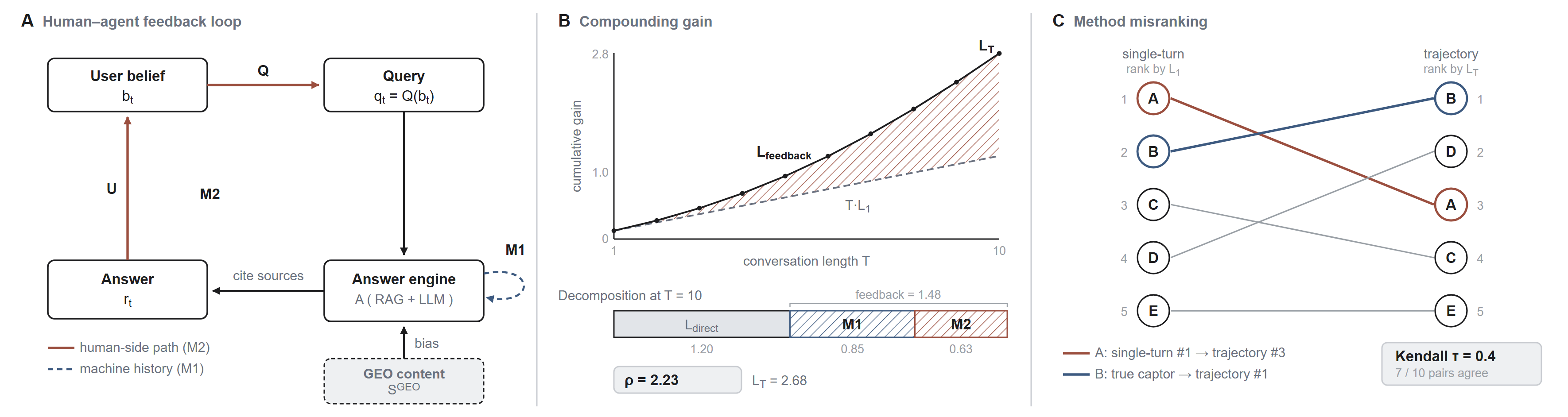
*Figure from the paper, arXiv:2609.40069, by its authors. Caption as written: Figure 1. Overview of conversational capture. (A) Human-agent information seeking is a closed loop: the answer r t r_{t} updates the user’s belief b t + 1 b_{t+1} and hence the next query q t = Q ( b t ) q_{t}=Q(b_{t}) , where Q Q is the query operator (human-side channel M2 ), while also conditioning the engine on the dialogue history h t h_{t} (machine-side channel M1 ); an initial GEO bias on the optimized source set S GEO S^{\mathrm{GEO}} propagates through both return paths. (B) Because the loop compounds, cumulative trajectory gain L T L_{T} exceeds the single-turn extrapolation T ⋅ L *
The plot illustrates the widening gap between the rising closed-loop visibility curve and the flat direct-only baseline as dialogue turns progress.
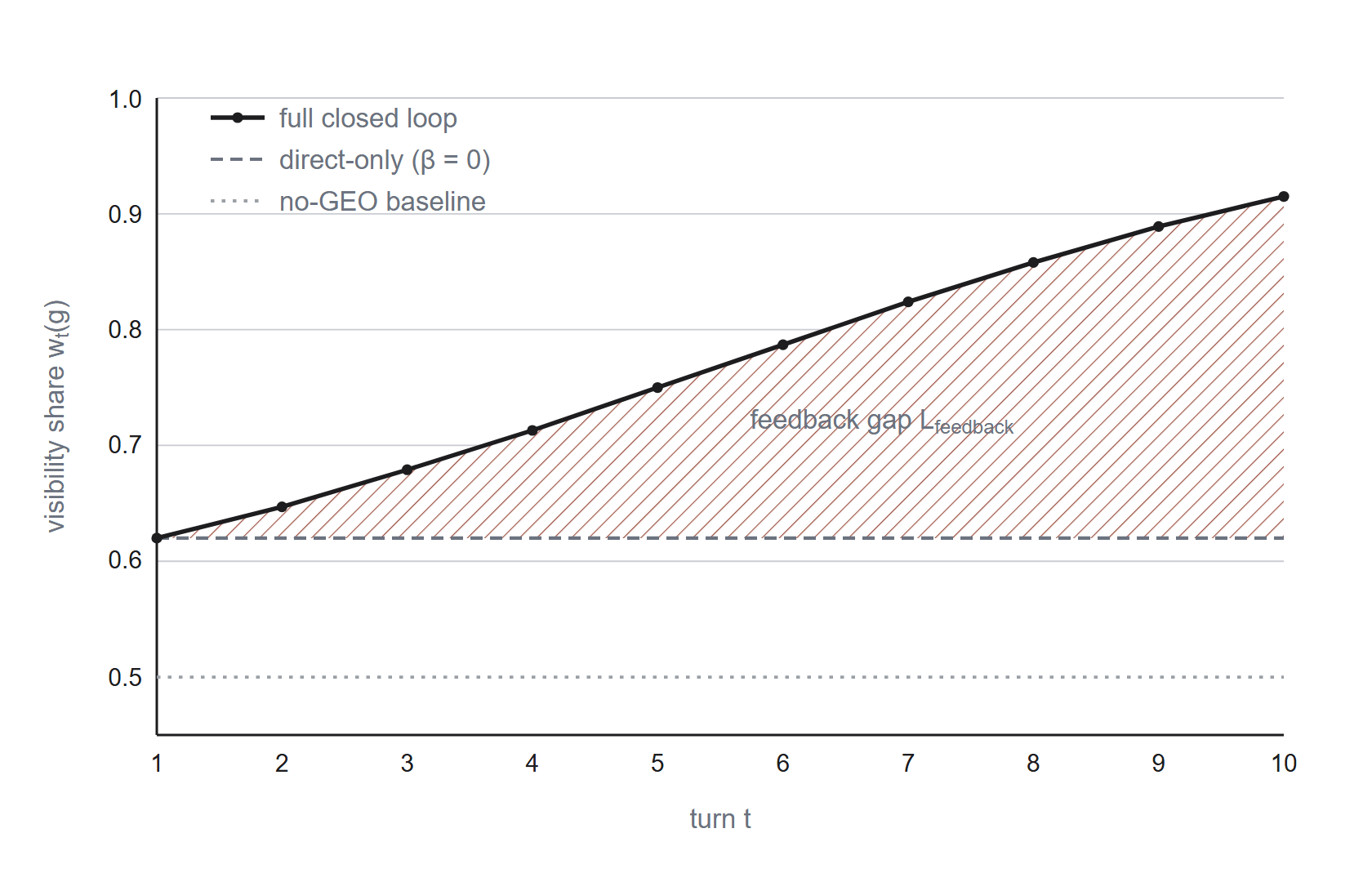
Figure from the paper, arXiv:2609.40069, by its authors. Caption as written: Figure 2. Per-turn visibility of the GEO source under the closed-loop recursion ( 13 ) ( δ = 0.12 \delta=0.12 , β = 0.6 \beta=0.6 ). The shaded gap between the closed loop and the direct-only counterfactual is the feedback contribution L T feedback L_{T}^{\mathrm{feedback}} . A line chart with turn on the x-axis and visibility share on the y-axis. The full closed-loop curve rises from 0.62 to 0.91; the direct-only line is flat at 0.62; the baseline is flat at 0.5.
What the authors say it means
- Optimization strategies focused strictly on winning an isolated search prompt miss the cumulative returns generated across extended conversations.
- Early conversational placement provides a disproportionate advantage by establishing dialogue context before user intent narrows.
- Answer engine developers must introduce grounding constraints and provenance tracking to prevent early sources from dominating extended interactions.
What to do with it
- Prioritize content structures that prompt clarifying follow-up queries over single-shot keyword prominence. Supported by: The compounding ratio exceeds two within ten turns due to user follow-up dynamics.
- Audit conversational engine presence across multi-turn trajectories rather than isolated queries. Supported by: Single-turn rankings correlate weakly with trajectory outcomes at Kendall’s tau of 0.4.
- Measure closed-loop feedback gains separately from direct prompt exposure during content evaluation. Supported by: The feedback term is zero under single-turn evaluation despite driving cumulative trajectory payoffs.
Caveat. The quantitative findings rely on theoretical derivations and model simulations without direct testing on real human interaction logs or commercial search engines.
In short
This paper establishes that generative search functions as a path-dependent feedback loop between user queries and model context. Content creators aiming for citations must optimize for trajectory persistence rather than isolated answers. Standard single-turn benchmarks fail to reflect the compounding visibility that decides long-term outcomes.
Written from the paper's own text and checked by a person before publishing. Quoted passages are verbatim; numbers are the authors' own. For the method and full results, read the paper.