Conversational Capture: A Trajectory-Level Framework for Evaluating Generative Engine Optimization in Multi-turn Human-Agent Interaction(对话俘获:多轮人机交互中生成式引擎优化的轨迹级评估框架)于 2026-09-30 提交到 arXiv,作者 Junwei Yu, Jieyu Zhou, Mufeng Yang, Yepeng Ding, Hiroyuki Sato。去 arXiv 读原文,或下载 PDF。
为什么和被引用有关
- 现有的单轮评估方法默认单轮之间相互独立,导致评估中的反馈项计算结果为零,无法体现早期回答对后续交互的影响。
- 在多轮交互中,前期的引用优势会持续累加,复合比率在十轮交互之内即可超过二。
- 单轮排名与多轮轨迹排名的相关性较低,二者的肯德尔等级相关系数仅为 0.4,依照单轮表现容易选错优化方法。
最重要的一点。 单轮测试无法准确判断内容优化的实际效果,因为多轮交互中的早期引用会引发闭环反馈并放大曝光量。
摘要
Generative Engine Optimization (GEO) shapes content to increase its likelihood of being cited by answer engines built on retrieval-augmented large language models. GEO is typically evaluated as a single-turn property: for a fixed query, an evaluator measures a source’s visibility in one answer. We argue that the single answer is an inadequate unit of analysis. Human-agent information seeking forms a closed loop: the agent’s answer changes the user’s beliefs and therefore the next question, which in turn determines what the agent retrieves. We introduce conversational capture, a phenomenon in which a source cited early becomes substantially more likely to be cited again. Capture operates through a machine-side channel, history-conditioned retrieval, and a human-side channel, follow-up questions directed toward the captured source. We formalize the interaction as a two-layer closed-loop system and derive trajectory-level constructs: cumulative conversational visibility; a direct/feedback decomposition of trajectory gain; a nested split of the feedback term into machine-side and human-side channels; a capture coefficient; a compounding ratio; and a misranking diagnostic. Using reinforcement-process (Pólya-urn) theory, we prove that the feedback term is zero under single-turn evaluation and that GEO’s cumulative payoff grows superlinearly with conversation length while capture develops. A model-derived illustration shows that the feedback term can exceed the direct term, the compounding ratio exceeds two within ten turns, and single-turn and trajectory rankings agree only weakly (Kendall’s $τ= 0.4$). We connect the human channel to information foraging, trust calibration, and Bayesian persuasion, and discuss design implications for answer engines.
译文:生成式引擎优化(GEO)通过调整内容形态,提高内容被基于检索增强大语言模型的回答引擎引用的概率。现有的 GEO 评估通常将可见性视为单轮属性:针对固定查询,评估者测量单一回答中某个信息源的可见程度。我们认为单一回答并不能作为合适的研究单元。人机信息获取构成了一个闭环:智能体的回答会改变用户的认知,从而改变后续提问,进而决定智能体接下来检索到的内容。我们提出了对话俘获现象,即早期被引用的信息源在后续轮次中再次被引用的概率会显著提高。俘获通过两个路径发挥作用:依赖对话历史检索的机器侧路径,以及引导追问流向被俘获信息源的人类侧路径。我们将这种交互形式化为一个双层闭环系统,并推导出轨迹级指标:累积对话可见度、轨迹增益的直接与反馈分解项、针对机器侧与人类侧的嵌套拆分、俘获系数、复合比率以及排序错误诊断。基于强化过程(波利亚罐)理论,我们证明了在单轮评估下反馈项恒等于零,且随着俘获过程的发展,GEO 的累积收益随对话长度呈超线性增长。基于模型的算例表明,反馈项可以超过直接项,复合比率在十轮内超过二,且单轮与轨迹排序仅呈现微弱的一致性(Kendall’s τ = 0.4)。我们将人类侧路径与信息觅食、信任校准和贝叶斯说服理论联系起来,并讨论了回答引擎的设计启示。
关键术语
- 生成式引擎优化 (GEO):通过调整网页内容结构以提高其在生成式回答引擎中被引用概率的做法。
- 对话俘获 (Conversational Capture):信息源在对话早期被引用后,即便后续需求转移,在后期仍有很高概率被再次引用的现象。
- 机器侧路径 (Machine-Side Channel):回答引擎将历史对话作为上下文输入,从而重复检索早期信息源的机制。
- 人类侧路径 (Human-Side Channel):用户在阅读回答后调整认知,并将后续追问引向已被引用信息源的过程。
- 复合比率 (Compounding Ratio):多轮累积曝光收益相比单轮简单外推收益的比值指标。
- 波利亚罐过程 (Pólya-urn Process):一种数学概率模型,某一类别被抽中会增加该类别在后续抽取中再次出现的概率。
论文原文
作者给出了对话俘获的明确定义,指出这一现象会导致引用脱离即时相关性。
In multi-turn generative retrieval, once a source is cited in earlier turns, its probability of being cited in later turns is significantly elevated; this persistence may be independent of the source’s relevance to the user’s current (narrowed or drifted) information need.
译文:在多轮生成式检索中,某个信息源一旦在较早轮次中被引用,其在后续轮次中被引用的概率就会显著提高;这种延续性可能独立于该信息源与用户当前收窄或漂移的信息需求之间的相关性。
作者阐述了搜索习惯向对话回答引擎的转变,以及优化内容的现实需求。
People increasingly obtain information by conversing with an answer engine rather than by selecting links from a ranked list. An answer engine combines a large language model (LLM) with a retrieval component to produce natural-language responses that often cite sources. This shift has prompted Generative Engine Optimization (GEO), the practice of adapting content so that answer engines surface and cite it preferentially ( Aggarwal et al., 2024 ) .
译文:人们越来越多地通过与回答引擎交谈来获取信息,不再只是从排序列表中筛选链接。回答引擎结合了大语言模型与检索组件,以生成通常带有引用来源的自然语言回复。这种转变催生了生成式引擎优化(GEO),即调整内容以使回答引擎优先呈现并引用它的实践。
作者总结了单轮评估为何无法反映多轮对话的路径依赖规律。
GEO is currently evaluated as if a conversation were a sequence of independent search queries, although an answer engine influences the user’s next question. An initial GEO advantage can therefore propagate through a human-agent feedback loop and compound. We call this phenomenon conversational capture. We formalized the loop, separated its machine-side and human-side channels, and defined trajectory-level evaluation constructs.
译文:尽管回答引擎会影响用户的下一个问题,但目前对 GEO 的评估仍将对话视为一系列独立的搜索查询。初始的 GEO 优势因此能够通过人机反馈回路传播并复合累积。我们称这一现象为对话俘获。我们对该回路进行了形式化建模,区分了机器侧与人类侧路径,并定义了轨迹级评估构念。
论文里的图
图 A 展示人机双路径闭环,图 B 展示轨迹增益高于单轮外推,图 C 展示单轮与轨迹排名的错位。
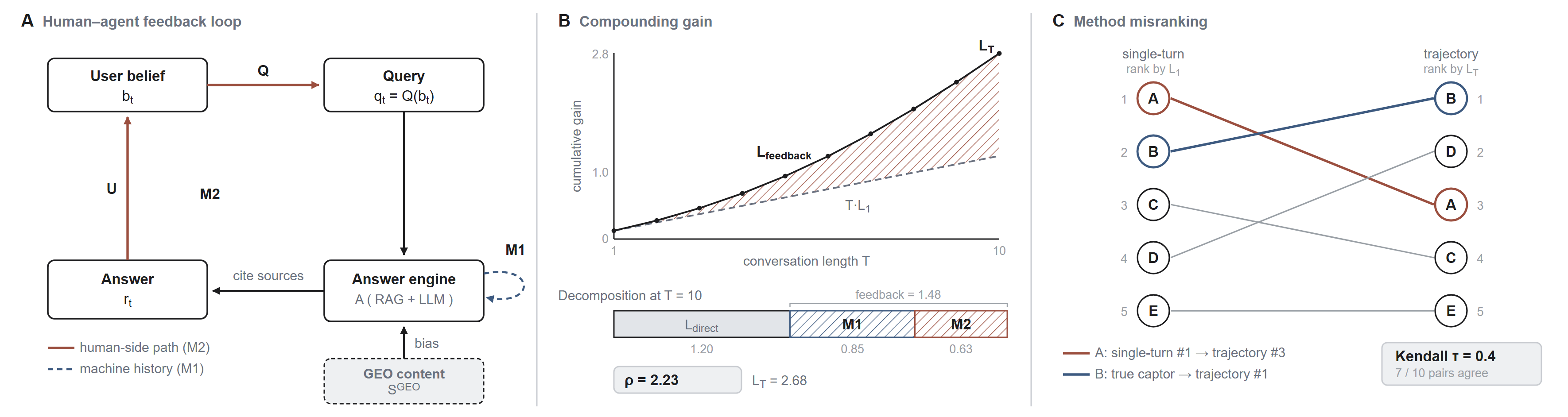
*图来自论文 arXiv:2609.40069,版权归作者。原图说明:Figure 1. Overview of conversational capture. (A) Human-agent information seeking is a closed loop: the answer r t r_{t} updates the user’s belief b t + 1 b_{t+1} and hence the next query q t = Q ( b t ) q_{t}=Q(b_{t}) , where Q Q is the query operator (human-side channel M2 ), while also conditioning the engine on the dialogue history h t h_{t} (machine-side channel M1 ); an initial GEO bias on the optimized source set S GEO S^{\mathrm{GEO}} propagates through both return paths. (B) Because the loop compounds, cumulative trajectory gain L T L_{T} exceeds the single-turn extrapolation T ⋅ L *
该折线图呈现了闭环曲线随对话轮次持续上升,与保持平稳的单轮直接增益线拉开差距。
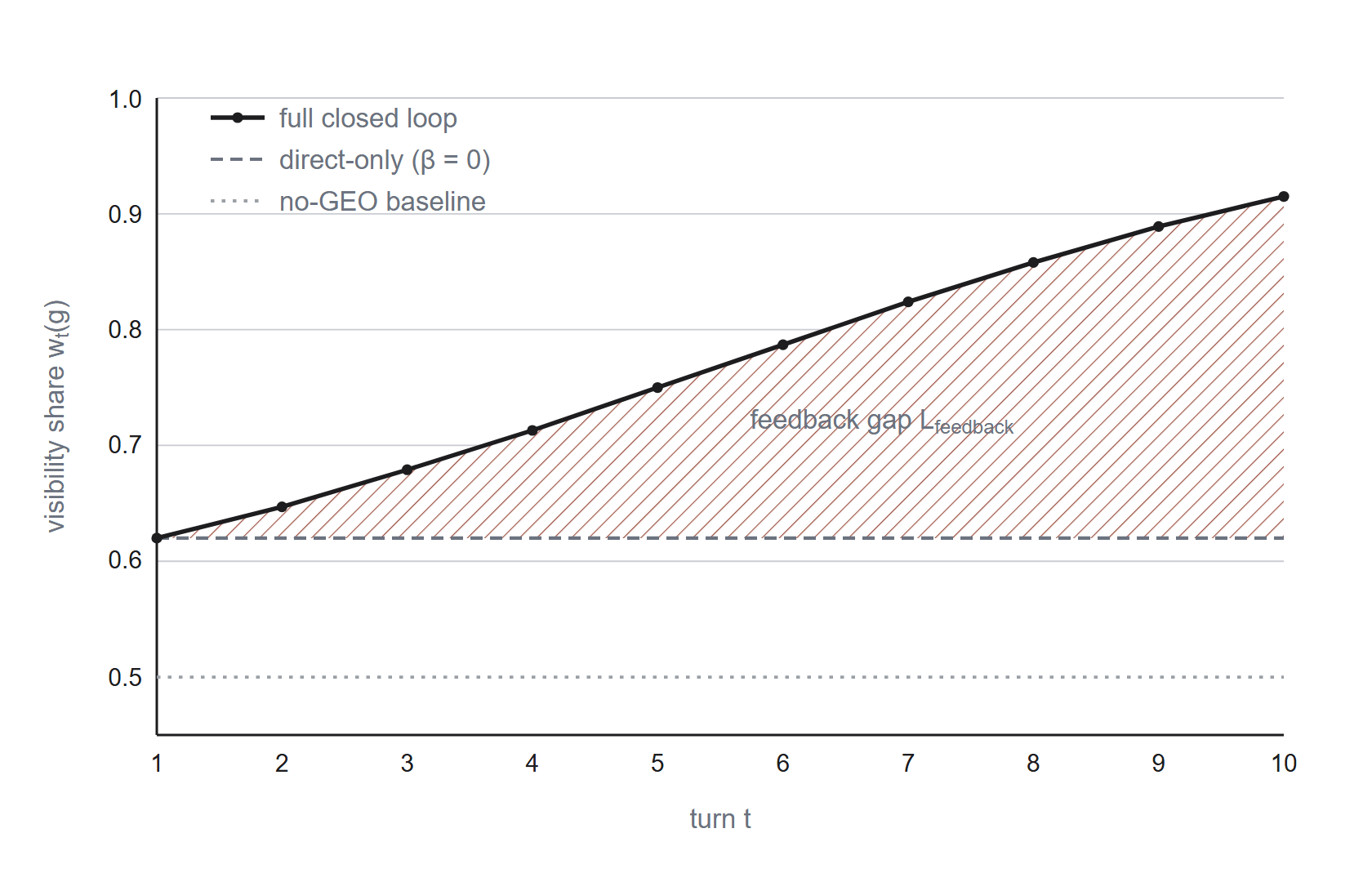
图来自论文 arXiv:2609.40069,版权归作者。原图说明:Figure 2. Per-turn visibility of the GEO source under the closed-loop recursion ( 13 ) ( δ = 0.12 \delta=0.12 , β = 0.6 \beta=0.6 ). The shaded gap between the closed loop and the direct-only counterfactual is the feedback contribution L T feedback L_{T}^{\mathrm{feedback}} . A line chart with turn on the x-axis and visibility share on the y-axis. The full closed-loop curve rises from 0.62 to 0.91; the direct-only line is flat at 0.62; the baseline is flat at 0.5.
作者自己说的含义
- 仅针对单次独立搜索提示词进行优化,会忽略多轮深度对话中带来的长期流量收益。
- 在对话早期获得引用具有决定性作用,它能在用户意图收窄之前锁定后续的上下文检索范围。
- 回答引擎平台需要增加对话历史削减机制和来源溯源提示,防止早期引用对后续轮次形成过度绑定。
可以怎么做
- 优化内容以引导用户提出后续追问,而不要局限于争夺单个关键词的即时曝光。 依据:人类侧追问机制会推动复合比率在十轮内增长到二以上。
- 在评估自身网页在生成式引擎中的可见度时,必须测量完整的多轮对话轨迹。 依据:单轮与轨迹级优胜排名的肯德尔等级相关系数仅为 0.4。
- 将单轮直接曝光增益与多轮反馈回路增益分开进行追踪和对比。 依据:单轮评估方法计算得出的反馈项结果恒等于零。
注意。 文中的具体数据基于理论模型推导和算例模拟,尚未在商业回答引擎或真实用户交互日志中完成验证。
一句话
这项研究表明生成式搜索具有显著的路径依赖特性,前期的引用会塑造后续的查询和检索过程。内容运营者需要关注整个对话过程中的持续可见性,而非单纯追逐单次曝光。传统的单轮评估体系会漏掉多轮累积效果,无法为内容策略提供可靠指引。
这篇解读根据论文原文写成,发布前有人看过。引用的段落是原话,数字都是作者自己报告的。方法和完整结果请读论文。