Auditing Source Exposure in Baidu and Google AI Search was submitted to arXiv on 2026-09-21 by Yibo Li, Enci Guan, Yuedan Cai, Geng Liu, Francesco Pierri. Read it on arXiv or as a PDF.
Why it matters for getting cited
- AI search engines can deliver answers with median cosine similarities ranging from 0.701 to 0.813 across platforms and languages while citing nearly distinct sets of websites.
- Overview availability differs sharply depending on the platform and query language.
- The pool of visible source domains in Chinese search overviews shows low aggregate overlap across search engines.
- Source exposure in AI search is concentrated among a small set of top domains rather than spread evenly across the web.
The main takeaway. Optimizing for AI search requires separate strategies for each engine and language because high answer similarity does not mean engines cite the same websites.
The abstract, as written
AI-generated overviews are becoming an increasingly prominent layer of search interfaces, yet their behavior in Chinese-language search remains underexplored. We conduct a cross-lingual audit of AI overview behavior on Baidu and Google using English queries sampled from MS MARCO and their translated Chinese counterparts. Our analysis examines when overviews are triggered across platform-language settings, which host domains receive visible exposure in Chinese-language overviews, how concentrated that exposure is, and how source overlap varies across settings. We also compare the embedding-based semantic similarity of generated answers for matched query intents. The results reveal substantial differences across platform-language settings in overview availability and visible source exposure. At the aggregate level, the settings exhibit low overlap in visible host-domain inventories, while matched-query answers yield median cosine similarities ranging from 0.701 to 0.813. These findings indicate that answer-level semantic similarity and aggregate source exposure capture distinct dimensions of AI-mediated search. Evaluations of AI search should therefore consider not only the content of generated answers but also how source visibility is distributed across platforms, languages, and information environments.
Key terms
- AI-generated overview: A synthesized answer displayed at the top of a search results page alongside links to selected source websites.
- Host domain: The specific website address, including subdomains, that identifies where a cited page is hosted.
- Cosine similarity: A mathematical metric between minus one and one that measures how close two pieces of text are in meaning based on their vector representations.
- Source concentration: The degree to which search overview citations are dominated by a small group of websites rather than distributed broadly.
- Jaccard similarity: A measurement of set overlap calculated by dividing the number of shared items by the total number of unique items across two groups.
From the paper
Answer semantic similarity and source overlap measure different aspects of AI search.
Because the two metrics operate at different levels of aggregation, we do not interpret this pattern as evidence of a query-level relationship between semantic similarity and source overlap. Instead, the results show that answer similarity and aggregate source exposure capture distinct dimensions of AI-mediated search.
Visible source diversity differs across platforms even when multiple links are shown.
The most visible Baidu Chinese sources were also primarily Baidu-owned subdomains. In contrast, Google Chinese exposed a broader mixture of encyclopedic, medical, commercial, and other external host domains. These findings show that displaying multiple source references does not necessarily imply broad source diversity.
Figures from the paper
Figure 5 displays the top cited host domains across Baidu Chinese, Google Chinese, and Google English.
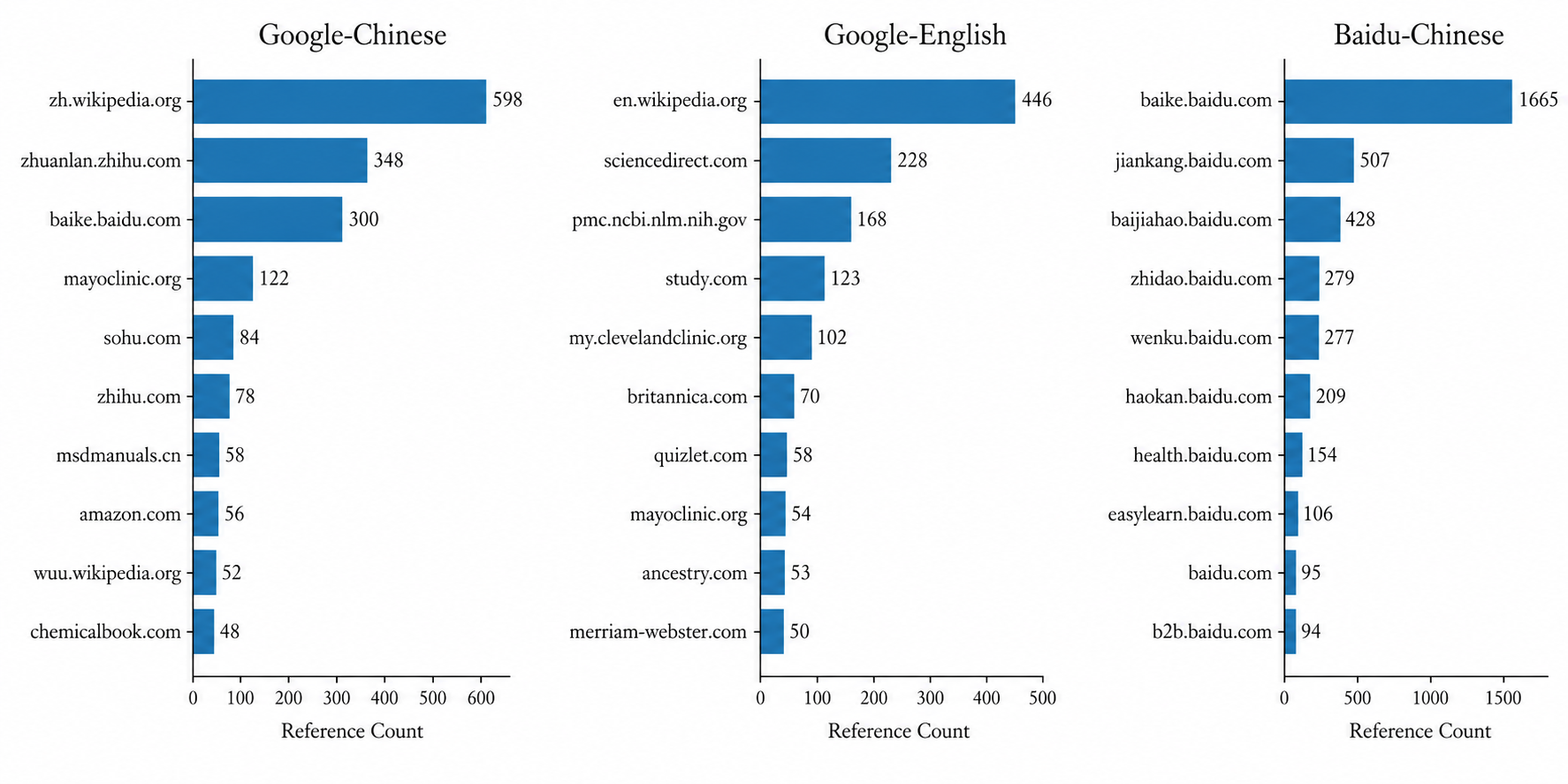
Figure from the paper, arXiv:2609.24407, by its authors. Caption as written: Figure 5: Overall top-referenced host domains across source-analysis settings. Baidu Chinese is dominated by Baidu-owned host domains, while Google Chinese and Google English expose a more mixed set of sources. Note that the x-axis scales differ across panels because reference counts differ substantially across settings.
Figure 6 displays the distribution of answer cosine similarity scores across matched query intents.
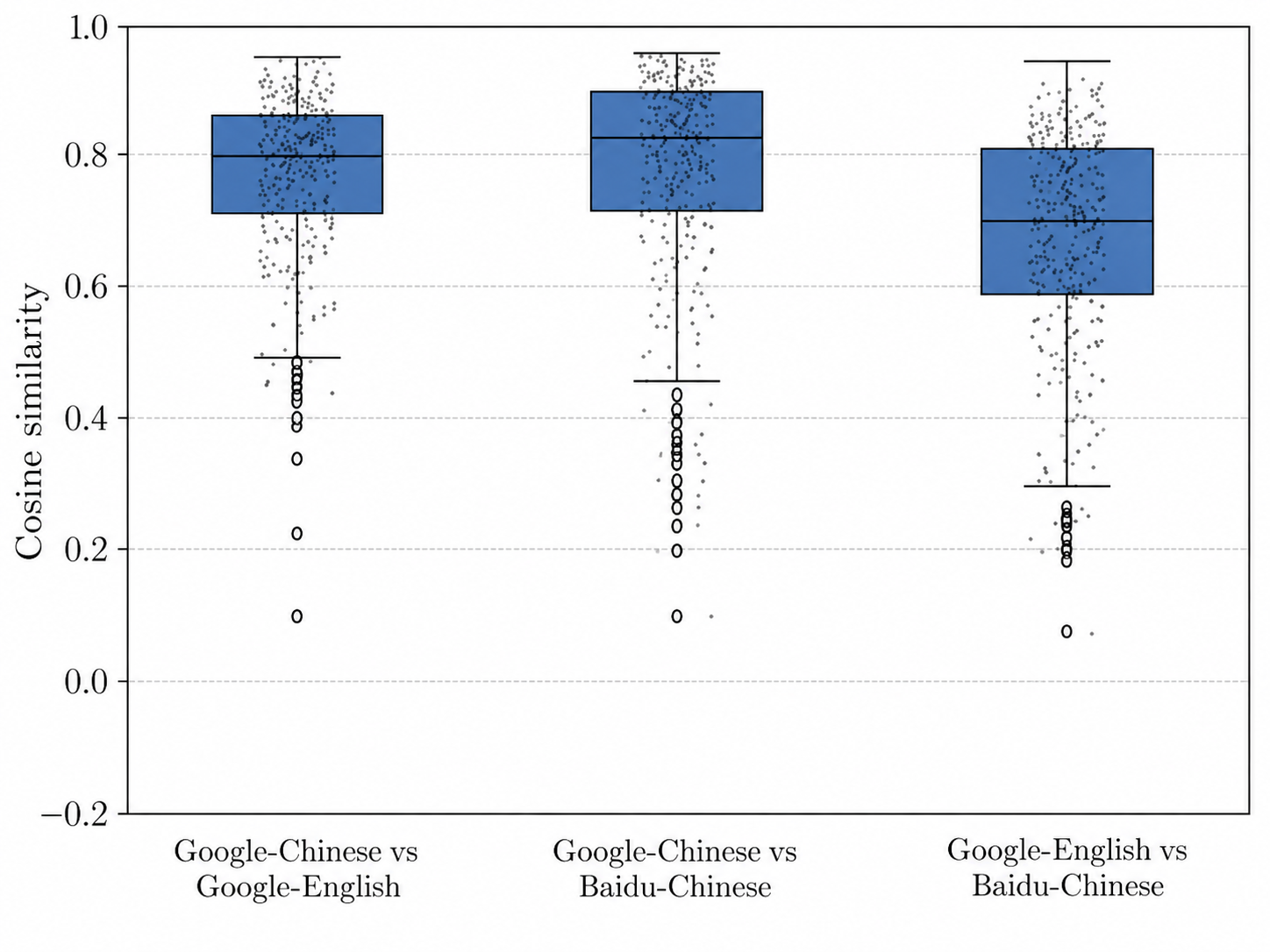
Figure from the paper, arXiv:2609.24407, by its authors. Caption as written: Figure 6: Query-level cosine similarity between generated answers for matched query intents. Only the common set of query intents for which all three settings successfully generated an overview is included. G-CN, G-EN, and B-CN denote Google Chinese, Google English, and Baidu Chinese, respectively. Boxes show the interquartile range, center lines indicate medians, and points represent matched queries.
What the authors say it means
- Auditing AI search engines by evaluating text answers alone misses how visibility is allocated to third-party publishers.
- Brands must track their citations across individual engines because winning visibility on Google does not translate to visibility on Baidu.
- Language choice changes source exposure, so cross-lingual content strategies must account for distinct local platform ecosystems.
What to do with it
- Track citations separately on each AI search platform rather than assuming common referral sources. Supported by:
- Establish a presence within platform-favored internal properties when targeting engines that rely heavily on their own ecosystems. Supported by:
- Monitor both generated answer text and linked sources to evaluate overall visibility in AI overviews. Supported by:
Caveat. The authors collected data from a single geographic location over a brief window using translated queries, so the results do not capture personalization, local rankings inside mainland China, or longitudinal changes.
In short
Baidu and Google generate comparable answers for aligned search intents but expose completely different sets of reference links. Visibility in AI search remains highly platform-dependent and concentrated. Marketers and researchers must treat answer quality and source citation as two separate problems.
Written from the paper's own text and checked by a person before publishing. Quoted passages are verbatim; numbers are the authors' own. For the method and full results, read the paper.