Auditing Source Exposure in Baidu and Google AI Search(审计百度与谷歌 AI 搜索中的来源曝光度)于 2026-09-21 提交到 arXiv,作者 Yibo Li, Enci Guan, Yuedan Cai, Geng Liu, Francesco Pierri。去 arXiv 读原文,或下载 PDF。
为什么和被引用有关
- 跨平台和跨语言的 AI 摘要答案中位数余弦相似度在 0.701 至 0.813 之间,但引用的网站来源几乎完全不同。
- AI 摘要的触发频率因搜索引擎平台和查询语言的不同而存在明显差异。
- 中文 AI 搜索摘要中展示的可见域名总体重合度非常低。
- AI 搜索中的来源曝光度高度集中在少数主要域名上,分布并不均衡。
最重要的一点。 做 AI 搜索优化必须针对具体平台和具体语言分别制定策略,因为回答内容相似并不代表搜索引擎会引用相同的网站。
摘要
AI-generated overviews are becoming an increasingly prominent layer of search interfaces, yet their behavior in Chinese-language search remains underexplored. We conduct a cross-lingual audit of AI overview behavior on Baidu and Google using English queries sampled from MS MARCO and their translated Chinese counterparts. Our analysis examines when overviews are triggered across platform-language settings, which host domains receive visible exposure in Chinese-language overviews, how concentrated that exposure is, and how source overlap varies across settings. We also compare the embedding-based semantic similarity of generated answers for matched query intents. The results reveal substantial differences across platform-language settings in overview availability and visible source exposure. At the aggregate level, the settings exhibit low overlap in visible host-domain inventories, while matched-query answers yield median cosine similarities ranging from 0.701 to 0.813. These findings indicate that answer-level semantic similarity and aggregate source exposure capture distinct dimensions of AI-mediated search. Evaluations of AI search should therefore consider not only the content of generated answers but also how source visibility is distributed across platforms, languages, and information environments.
译文:人工智能生成的摘要正逐渐成为搜索界面的核心层,但其在中文搜索中的表现仍缺乏充分研究。我们利用来自 MS MARCO 的英文查询及其对应的中文翻译,对百度和谷歌上的 AI 摘要行为进行了跨语言审计。分析探讨了各平台与语言设置下摘要的触发时机、中文摘要中哪些主域名获得了展示、这些曝光的集中程度如何,以及不同设置间来源重合度的变化。我们还对比了匹配查询意图下生成答案的语义嵌入相似度。结果显示,各平台与语言设置在摘要可用性和可见来源曝光方面存在显著差异。在总体层面,各设置可见主域名库的重合度较低,而匹配查询答案的中位数余弦相似度在 0.701 至 0.813 之间。这些发现表明,答案层面的语义相似度与总体来源曝光反映了 AI 辅助搜索的不同维度。因此,评估 AI 搜索不仅应关注生成答案的内容,还应考虑来源可见性如何在不同平台、语言和信息环境中分布。
关键术语
- AI 生成摘要:在搜索结果顶部生成的综合回答,同时附带引用的来源网页链接。
- 主域名:用来标识引用网页所属站点的具体网络地址,包含二级域名。
- 余弦相似度:介于负一到正一之间的数值,通过文本向量表示来衡量两段文字在含义上的接近程度。
- 来源集中度:衡量搜索引用是否主要由极少数网站占据指标。
- 杰卡德相似度:通过计算两组集合共有元素的数量占所有不同元素总数的比例,来衡量集合重合程度的指标。
论文原文
答案语义相似度与来源重合度衡量的是 AI 搜索的两个不同方面。
Because the two metrics operate at different levels of aggregation, we do not interpret this pattern as evidence of a query-level relationship between semantic similarity and source overlap. Instead, the results show that answer similarity and aggregate source exposure capture distinct dimensions of AI-mediated search.
译文:由于这两个指标所处的聚合层级不同,我们并不认为这种模式代表语义相似度与来源重合度在单条查询层面存在对应关系。结果表明,答案相似度与总体来源曝光度体现了人工智能搜索的不同维度。
即便展示了多个链接,不同平台之间的来源多样性依然存在差异。
The most visible Baidu Chinese sources were also primarily Baidu-owned subdomains. In contrast, Google Chinese exposed a broader mixture of encyclopedic, medical, commercial, and other external host domains. These findings show that displaying multiple source references does not necessarily imply broad source diversity.
译文:百度中文中最醒目的来源主要是百度自有的二级域名。相比之下,谷歌中文展示了包含百科、医疗、商业等更多外部域名的混合来源。这些发现表明,展示多个来源引用并不等于具备广泛的来源多样性。
论文里的图
图 5 展示了百度中文、谷歌中文与谷歌英文中被引用频次最高的主域名分布情况。
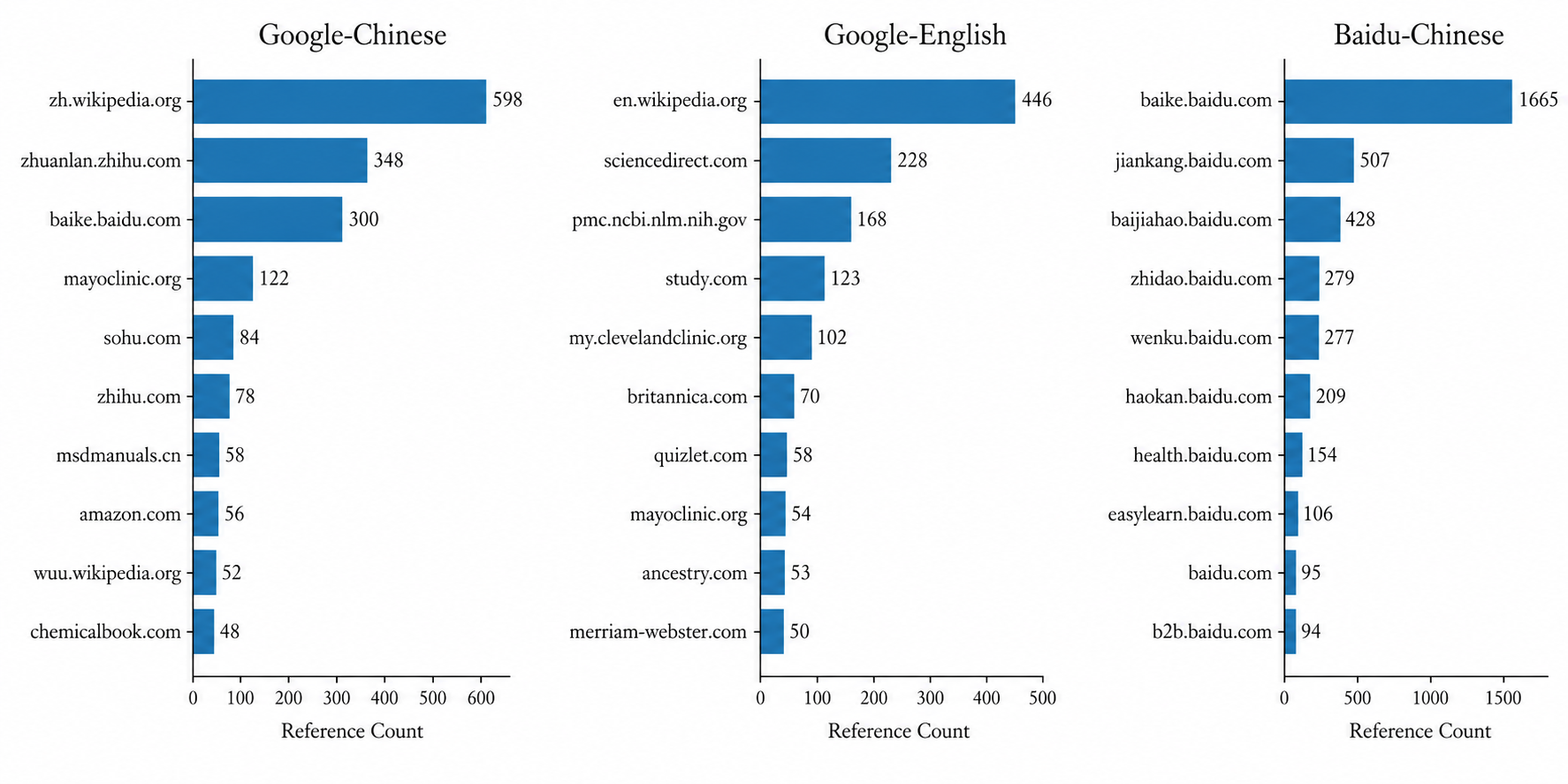
图来自论文 arXiv:2609.24407,版权归作者。原图说明:Figure 5: Overall top-referenced host domains across source-analysis settings. Baidu Chinese is dominated by Baidu-owned host domains, while Google Chinese and Google English expose a more mixed set of sources. Note that the x-axis scales differ across panels because reference counts differ substantially across settings.
图 6 展示了匹配意图查询在各平台与语言设置下生成答案的余弦相似度分布。
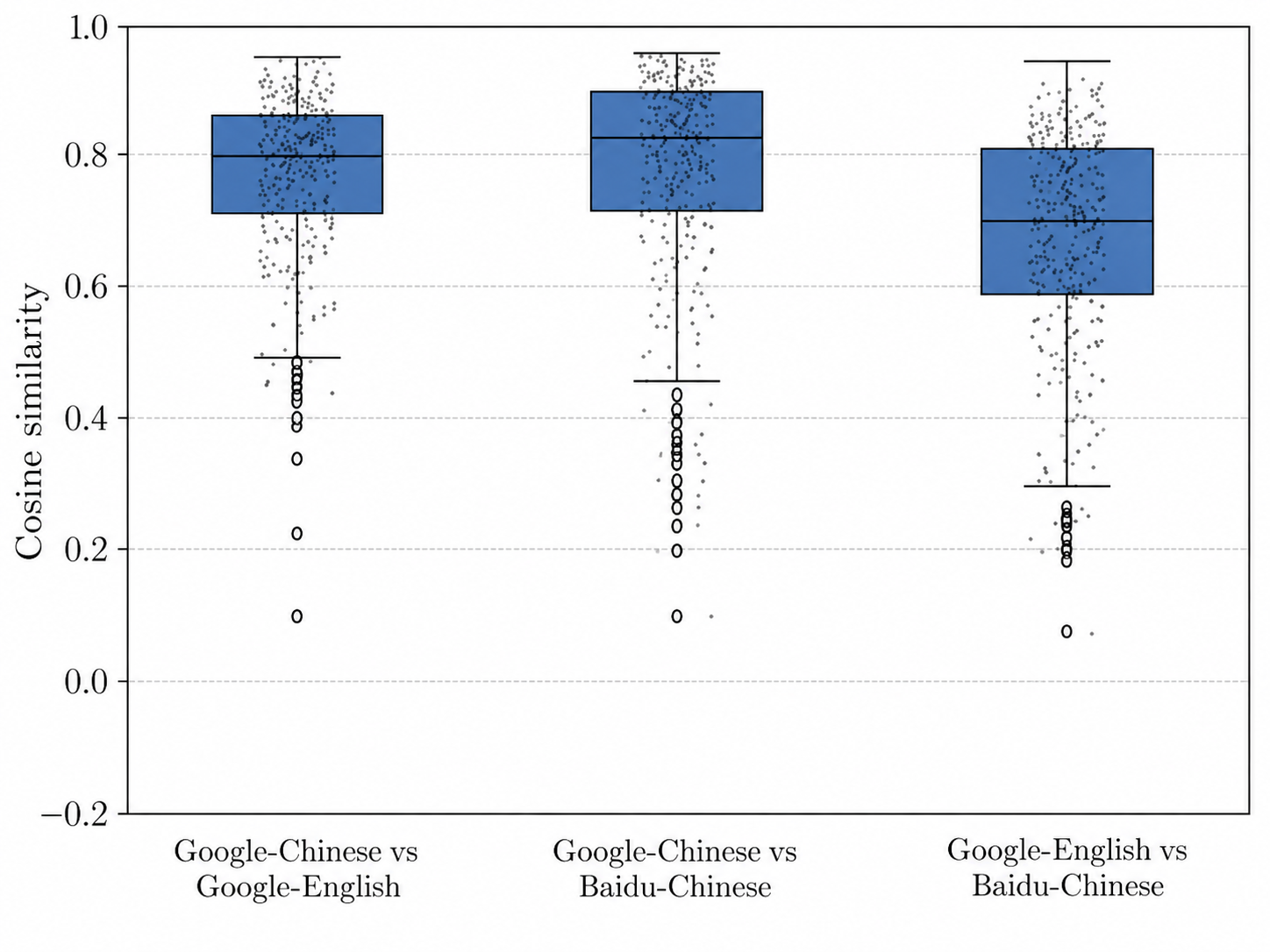
图来自论文 arXiv:2609.24407,版权归作者。原图说明:Figure 6: Query-level cosine similarity between generated answers for matched query intents. Only the common set of query intents for which all three settings successfully generated an overview is included. G-CN, G-EN, and B-CN denote Google Chinese, Google English, and Baidu Chinese, respectively. Boxes show the interquartile range, center lines indicate medians, and points represent matched queries.
作者自己说的含义
- 只评估 AI 生成的文本答案无法反映第三方网站在搜索界面中获得的实际曝光。
- 企业需要为不同引擎单独监测引用情况,在谷歌获得的曝光无法直接转变为百度的曝光。
- 查询语言会改变曝光的来源生态,跨语言传播必须结合当地平台环境开展运营。
可以怎么做
- 单独追踪每个 AI 搜索引擎的引用情况,避免将不同平台的来源混为一谈。 依据:
- 针对依赖自有生态的搜索引擎,优先在其支持的平台内建立品牌内容。 依据:
- 同时监测生成的文本回答和底部附带的链接,全面评估在 AI 搜索中的曝光效果。 依据:
注意。 研究数据采集自单一海外地点且持续时间较短,查询也采用机器翻译,未反映中国大陆本土网络环境、用户个性化以及长期变化情况。
一句话
百度与谷歌在处理相同信息需求时给出的回答大体一致,但推荐的参考网站完全不同。AI 搜索中的流量曝光存在很强的平台依赖性与集中度。从业者必须将文本生成质量与外链曝光作为两项独立的指标来评估。
这篇解读根据论文原文写成,发布前有人看过。引用的段落是原话,数字都是作者自己报告的。方法和完整结果请读论文。