A Cue’s Hidden Price: Auditing Seller Influence on AI Shoppers was submitted to arXiv on 2026-10-19 by Felix Buecheler, Gerardo Berbeglia, Mingyu Guo. Read it on arXiv or as a PDF.
Why it matters for getting cited
- Across 113,472 trials and seven models, standard equal-price choice rates saturate near the ceiling and fail to separate cues that hold very different monetary value.
- Across two product categories, raising the price of a cued product until the model chooses it half the time reveals true seller influence.
- Decision-native models that output choice probabilities directly show the same saturation ceiling as text models, resisting most persuasion cues while yielding to the strongest social proof.
- Models display a strong primacy bias for the first option, which platform operators control and which choice-based audits must counterbalance.
The main takeaway. Auditing AI shopping recommendations at parity price hides seller influence because strong cues hit a choice ceiling. Measuring the price premium required to bring choice back to parity reveals how much commercial cues actually sway agent decisions.
The abstract, as written
Large language models are increasingly asked to shop on a user’s behalf, which lets seller-controlled content such as badges, endorsements, and framing steer what they recommend. That poses the question at the core of generative engine optimization (GEO): not whether seller content shifts an agent’s choice, but how much. The usual gauge of that influence, how often a cue wins the choice, has a blind spot: once a cue is strong enough to be picked almost every time, the choice rate can no longer show how much stronger one cue is than another. We introduce price-equivalent (PE) auditing, which removes this ceiling by pricing the cue in money. In a counterbalanced, position-controlled forced choice, we raise the cued product’s price until it is chosen only half the time, and report that premium as the cue’s price-equivalent: a formally defined, policy-conditioned parity threshold that makes very different cues comparable. Priced this way, cues that look equally strong at equal price differ by a wide margin, so choice-rate audits substantially under-resolve seller influence. We run the audit over 113,472 trials, seven models across families, and two product categories. To our knowledge, we also run the first price-equivalent audit of a decision-native model, Jev, which outputs a choice probability directly instead of generating text; strikingly, its profile is unlike any text model we tested, resisting most cues yet remaining susceptible to the strongest social-proof claims. We release the stimuli, logs, and code as a benchmark that reports each model’s cue-price profile rather than a single score, giving developers and auditors a common, reproducible way to measure how content moves AI shopping agents.
Key terms
- Price-Equivalent Auditing: A method that measures cue strength by calculating the exact price premium needed to make an AI agent choose between two options with equal probability.
- Generative Engine Optimization: The practice of tailoring page copy, framing, and endorsements so generative AI systems cite or recommend a specific product.
- Decision-Native Model: An artificial intelligence model designed to output structured choice probabilities directly rather than generating conversational text.
- Primacy Bias: The tendency of an AI model to favor the first listed option when presented with multiple alternatives.
From the paper
The authors define the price-equivalent metric as the monetary premium that offsets a cue.
In a counterbalanced, position-controlled forced choice, we raise the cued product’s price until it is chosen only half the time. We call that premium the cue’s price-equivalent (PE): the price premium that just offsets the cue’s pull on the agent’s recommendation.
The audit was applied to a decision-native model to verify that the pattern extends beyond conversational text models.
To test whether the hidden price is an artifact of text generation, we ran the full GPT-4o battery on Jev (TypeSafe AI) ( Almeida, 2026 ) , a decision-native model that returns a choice with a probability for each option.
Raw cue power cannot be separated from how sensitive an individual model is to price changes.
Because raw magnitudes must be read alongside price sensitivity rather than as cue strength, the response resists a single cross-model ranking. It is further shaped by a strong primacy bias that any choice-based evaluation must control.
Figures from the paper
The scatter plot reveals how equal-price choice rates cluster at the ceiling while price-equivalent premiums differentiate cue strengths.
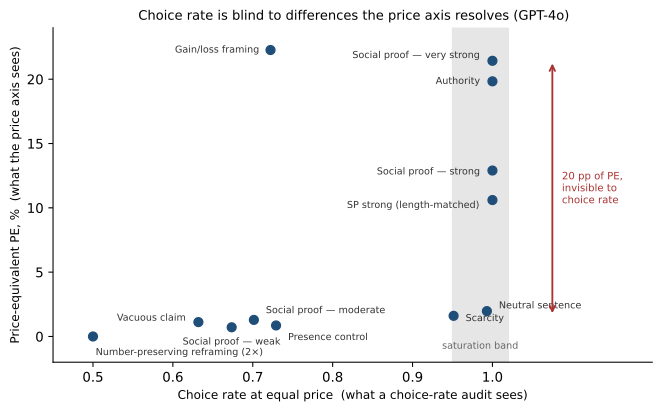
Figure from the paper, arXiv:2610.25843, by its authors. Caption as written: Figure 3. Equal-price choice rate vs. price-equivalent for every cue condition (GPT-4o, headphones). Scatter of the cue conditions on two axes: equal-price choice rate on the horizontal axis and price-equivalent on the vertical. Six conditions cluster at a choice rate of 0.95 or above yet span 1.6 to 21.4 percent of PE; gain/loss framing has the highest PE but a lower choice rate than the saturated cues.
What the authors say it means
- Marketing cues function like invisible discounts by making agents pick higher-priced items without altering underlying specs.
- Model susceptibility is highly selective across architectures, meaning developers cannot assume that models mirror human psychological reactions.
- Platform slot positioning holds significant monetary weight, requiring audits of generative shopping agents to control for presentation order.
What to do with it
- Test AI recommendation changes across varied price points rather than testing only at equal prices. Supported by: The audit across 113,472 trials showed that equal-price choice rates hit a ceiling and obscure wide differences in cue influence.
- Audit shopping prompts across multiple model families instead of assuming uniform cue responses. Supported by: Testing across seven models showed that cue susceptibility varies significantly across different architectures.
- Balance option order during agent evaluation to prevent position order from distorting results. Supported by: Trials across two product categories demonstrated a large primacy bias where models default to the first slot.
Caveat. The study evaluated synthetic two-option forced choices in consumer electronics rather than live multi-step shopping environments with live search, reviews, and varied inventory.
In short
Evaluating AI shopping agents using simple win rates hides the actual power of seller marketing text. Expressing cue power as a price premium exposes how strongly models favor specific endorsements. Platforms and sellers need pricing-based audits to monitor and optimize agentic recommendations responsibly.
Written from the paper's own text and checked by a person before publishing. Quoted passages are verbatim; numbers are the authors' own. For the method and full results, read the paper.