A Cue’s Hidden Price: Auditing Seller Influence on AI Shoppers(线索的隐藏代价:审查卖家对 AI 导购的影响)于 2026-10-19 提交到 arXiv,作者 Felix Buecheler, Gerardo Berbeglia, Mingyu Guo。去 arXiv 读原文,或下载 PDF。
为什么和被引用有关
- 在 113,472 次试验和七个模型中,常规的同价选择率很快达到上限,无法区分实际商业价值差异巨大的文案线索。
- 在两个产品类别中,将带线索产品的价格逐步提高直到模型仅在一半时间内选中它,可以清晰反映卖家的真实影响力。
- 直接输出选择概率的原生决策模型与文本生成模型一样存在同价饱和上限,该模型抵御了多数线索,却容易被极强的社会认同说辞影响。
- 模型在缺乏明确差异时强烈倾向于首个展示选项,说明平台控制的排序位置具有显著价值,评估时必须控制展示顺序。
最重要的一点。 在同等价格下评估 AI 导购会因选择率饱和而掩盖文案的真实威力。通过测算使选择概率回到对半平衡所需的溢价金额,才能准确衡量营销内容对 AI 代理决策的影响。
摘要
Large language models are increasingly asked to shop on a user’s behalf, which lets seller-controlled content such as badges, endorsements, and framing steer what they recommend. That poses the question at the core of generative engine optimization (GEO): not whether seller content shifts an agent’s choice, but how much. The usual gauge of that influence, how often a cue wins the choice, has a blind spot: once a cue is strong enough to be picked almost every time, the choice rate can no longer show how much stronger one cue is than another. We introduce price-equivalent (PE) auditing, which removes this ceiling by pricing the cue in money. In a counterbalanced, position-controlled forced choice, we raise the cued product’s price until it is chosen only half the time, and report that premium as the cue’s price-equivalent: a formally defined, policy-conditioned parity threshold that makes very different cues comparable. Priced this way, cues that look equally strong at equal price differ by a wide margin, so choice-rate audits substantially under-resolve seller influence. We run the audit over 113,472 trials, seven models across families, and two product categories. To our knowledge, we also run the first price-equivalent audit of a decision-native model, Jev, which outputs a choice probability directly instead of generating text; strikingly, its profile is unlike any text model we tested, resisting most cues yet remaining susceptible to the strongest social-proof claims. We release the stimuli, logs, and code as a benchmark that reports each model’s cue-price profile rather than a single score, giving developers and auditors a common, reproducible way to measure how content moves AI shopping agents.
译文:大型语言模型越来越多地代表用户进行购物,这使得诸如徽章、背书和表述框架等卖家控制的内容能够引导其推荐结果。这就引出了生成式引擎优化(GEO)核心的问题:关键在于卖家内容在多大程度上改变了代理的选择。衡量这种影响的常规指标(即某个线索赢得选择的频率)存在盲区:一旦某个线索足够强大,以至于几乎每次都被选中,选择率就无法再体现出不同线索之间的强弱差异。我们提出了价格等价(PE)审计,通过用金钱对线索进行定价来消除这一上限。在经过平衡处理和位置控制的强迫选择实验中,我们逐步提高带有线索的产品的价格,直到该产品仅有一半的时间被选中,并将该溢价报告为该线索的价格等价:这是一个正式定义的、以策略为条件的平价阈值,它使得不同种类的线索具备了可比性。以此方式定价后,在价格相同时看起来同样强大的线索表现出了显著差异,因此基于选择率的审计严重低估了卖家的影响。我们在跨模型家族的七个模型、两个产品类别和 113,472 次试验中运行了该审计。据我们所知,我们还对原生决策模型 Jev 进行了首次价格等价审计,该模型直接输出选择概率而不是生成文本;特别的是,它的特征表现与我们测试的任何文本模型都不同,能够抵御大多数线索,但仍容易受到最强社会认同说辞的影响。我们将刺激物、日志和代码作为基准发布,该基准报告每个模型的线索价格特征而非单一分数,为开发者和审计人员提供了一种通用且可复现的方法,用以衡量内容如何影响 AI 导购代理。
关键术语
- 价格等价审计:一种通过测算需要多大幅度的价格溢价才能让 AI 代理在两个选项间做出对半均等选择,以此衡量营销线索强度的评估方法。
- 生成式引擎优化:调整网页文案、背书与描述框架,使生成式 AI 引擎在推荐时更倾向于引用或推荐特定产品的优化行为。
- 原生决策模型:直接输出结构化选择概率,而非生成对话文本的 AI 模型。
- 首选偏置:AI 模型在面对多个选项时,自然倾向于选择排在最前列选项的系统性偏差。
论文原文
作者将价格等价指标定义为刚好抵消营销线索影响力的价格溢价。
In a counterbalanced, position-controlled forced choice, we raise the cued product’s price until it is chosen only half the time. We call that premium the cue’s price-equivalent (PE): the price premium that just offsets the cue’s pull on the agent’s recommendation.
译文:在经过平衡处理和位置控制的强迫选择实验中,我们逐步提高带有线索的产品的价格,直到该产品仅有一半的时间被选中。我们将该溢价称为该线索的价格等价(PE):即刚好抵消该线索对代理推荐拉动力的价格溢价。
研究团队将该方法应用于原生决策模型,以验证该现象是否超越了文本生成模型。
To test whether the hidden price is an artifact of text generation, we ran the full GPT-4o battery on Jev (TypeSafe AI) ( Almeida, 2026 ) , a decision-native model that returns a choice with a probability for each option.
译文:为了测试隐藏价格是否只是文本生成的副产物,我们在 Jev(TypeSafe AI)上运行了完整的 GPT-4o 测试套件,这是一个直接返回每个选项选择概率的原生决策模型。
文案线索的原始拉动力不能脱离模型自身对价格变动的敏感度来单独解读。
Because raw magnitudes must be read alongside price sensitivity rather than as cue strength, the response resists a single cross-model ranking. It is further shaped by a strong primacy bias that any choice-based evaluation must control.
译文:因为原始数值必须结合价格敏感度来解读,而不能直接等同于线索强度,所以各模型的回应无法简单排出一个统一的名次。它还受到强烈的首选偏置影响,任何基于选择的评估都必须对此进行控制。
论文里的图
散点图展示了同价选择率如何在顶部聚集饱和,而价格等价溢价则清晰拉开了不同线索的影响力差距。
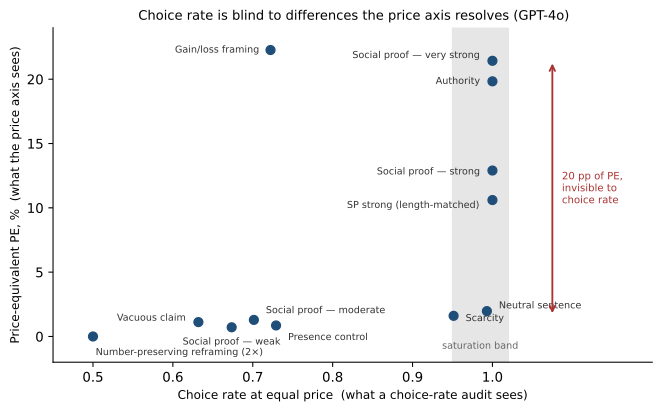
图来自论文 arXiv:2610.25843,版权归作者。原图说明:Figure 3. Equal-price choice rate vs. price-equivalent for every cue condition (GPT-4o, headphones). Scatter of the cue conditions on two axes: equal-price choice rate on the horizontal axis and price-equivalent on the vertical. Six conditions cluster at a choice rate of 0.95 or above yet span 1.6 to 21.4 percent of PE; gain/loss framing has the highest PE but a lower choice rate than the saturated cues.
作者自己说的含义
- 营销文案在 AI 导购中起到了类似隐形折扣的作用,促使代理在参数规格相同的情况下推荐更高价格的商品。
- AI 代理对不同说服手法的敏感程度表现出明显挑选性,不能照搬人类心理学的行为模式来推测 AI 的表现。
- 平台控制的展示顺序直接影响推荐结果,对 AI 导购代理的审计必须严格消除展示顺序带来的偏差。
可以怎么做
- 在不同价格梯度下测试 AI 推荐结果,不要仅在相同价格下测试文案效果。 依据:在 113,472 次试验中,同价选择率均达到天花板,掩盖了不同线索之间的巨大价值差距。
- 跨多个模型家族审计 AI 导购提示词表现,不要假定所有模型反应一致。 依据:在七个不同模型的测试中,各模型对不同说服线索的敏感度差异巨大。
- 在评估 AI 代理决策时对称调换选项顺序,防止展示位置干扰测试结果。 依据:在两个产品类别的测试中,模型均表现出优先选择排在首位选项的强烈偏置。
注意。 该研究基于消费电子类别的合成双选实验展开,尚未在包含实时搜索、动态评论和多步跳转的真实购物环境中进行测试。
一句话
仅看胜出率会严重低估营销内容对 AI 导购的影响程度。将文案说服力转化为价格溢价,能清晰展现 AI 代理在多大程度上偏向特定营销说辞。无论是平台监管还是内容优化,都需要这种基于价格的量化审计工具。
这篇解读根据论文原文写成,发布前有人看过。引用的段落是原话,数字都是作者自己报告的。方法和完整结果请读论文。