Location, Location, Generation: Where You Ask Matters for Generative Engine Optimization was submitted to arXiv on 2026-10-16 by Mahe Chen, Nick Koudas. Read it on arXiv or as a PDF.
Why it matters for getting cited
- Across 31,200 answers collected for 300 questions, user location heavily shifted which sources generative engines cited.
- ChatGPT followed 19 declared locations down to the city level, writing the city into searches and localizing backend results while ignoring network signals.
- Gemini evaluated across five network locations ignored declared coordinates and followed the network country, replacing sources even for queries that do not depend on place.
- The specific businesses and brands recommended in the answers changed directly alongside the cited sources.
The main takeaway. Visibility in generative search depends directly on the location of the user, so optimization and tracking must actively control both declared application cities and network country routing.
The abstract, as written
Generative search engines answer local and commercial questions with a written answer and a few cited sources. A growing practice of generative engine optimization (GEO) monitors which sources and brands these answers show, typically from a single place. In this paper, we present a controlled audit of how the user’s location changes the sources that generative engines cite. We ask 300 questions of ChatGPT with 19 declared locations, and of ChatGPT and Gemini from five network locations, each twice to measure run-to-run noise (31,200 answers). The engines take location from different channels. ChatGPT follows the location an application declares, down to the city: it writes the place into its own searches, and its search backend localizes results even when the queries name no place. It ignores the network. Gemini ignores the declared location and follows the country of the network, changing most of its sources even for questions that do not depend on place. The businesses the answers recommend change with the sources. Thus, visibility in generative search is specific to the user’s location, and audits must control both channels.
Key terms
- Generative engine optimization: The process of structuring and distributing web content so artificial intelligence search tools select it as a cited reference.
- Declared location: A geographic place explicitly passed to an artificial intelligence tool through an application parameter.
- Network location: The geographic origin detected by an engine from the internet routing of an incoming query.
- Localization index: A measurement of how much cited website domains diverge between geographic settings beyond normal random variation.
- Twin run: A duplicate query submitted under identical conditions to measure the baseline randomness of an engine.
From the paper
ChatGPT relies on declared application locations to steer its automated web queries and internal search results.
ChatGPT follows the location an application declares, down to the city: it writes the place into its own searches, and its search backend localizes results even when the queries name no place. It ignores the network.
Gemini determines location strictly from the network country and swaps both citations and recommendations.
Gemini ignores the declared location and follows the country of the network, changing most of its sources even for questions that do not depend on place. The businesses the answers recommend change with the sources.
The two generative engines treat spatial distance at fundamentally different levels of granularity.
Thus, to ChatGPT every other city is a different place; to Gemini, only another country is.
Figures from the paper
This plot shows how cited domains diverge across question categories when varying declared cities in ChatGPT and network locations in Gemini.
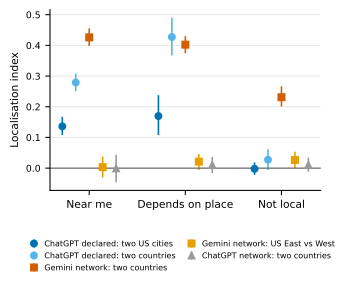
Figure from the paper, arXiv:2610.24081, by its authors. Caption as written: Figure 1. Localization index of cited domains (twin overlap minus overlap between settings; 95% CI over questions). Declared: ChatGPT with a stated city (E1). Network: no stated location, different network locations (E2). Dot plot of the localization index for three question groups. ChatGPT with declared locations and Gemini with network locations in different countries show large positive values for near-me and place-dependent questions; Gemini also for not-local questions. ChatGPT with network locations and Gemini between US East and US West stay at zero.
What the authors say it means
- Auditing brand visibility from a single location produces incomplete data that fails to represent what users see in other markets.
- Local businesses must build city-level relevance to appear in ChatGPT while focusing on country-wide authority for Gemini.
- Measurement tools must actively supply both explicit location parameters and regional network connections to get reliable results.
What to do with it
- Audit brand citations across multiple declared target cities when tracking ChatGPT performance. Supported by: ChatGPT localizes search queries and cited domains according to the declared city.
- Route Gemini tracking requests through network endpoints located in each target country. Supported by: Gemini selects sources based on the network country and ignores declared coordinates.
- Maintain location-specific landing pages and regional citations to win recommendations in generative answers. Supported by: The businesses recommended by generative answers change directly with the cited local sources.
Caveat. The study tested developer programming interfaces under controlled queries and did not examine consumer web interfaces where personal browsing histories might alter localization.
In short
The geographic location of an inquiry dictates which sources an artificial intelligence engine cites and which brands it recommends. Because ChatGPT localizes by declared city and Gemini localizes by network country, marketers must manage both technical pathways. Auditing generative search visibility from a single static setup will miss regional differences.
Written from the paper's own text and checked by a person before publishing. Quoted passages are verbatim; numbers are the authors' own. For the method and full results, read the paper.