Breaking News Out of the Filter Bubble: Generative AI Search Diversifies Collective Attention and Raises Shared Information Consumption was submitted to arXiv on 2026-09-30 by Heeseung Andrew Lee, Dokyun Lee, Gwanhoo Lee, Dongwon Lee. Read it on arXiv or as a PDF.
Why it matters for getting cited
- A randomized field experiment with 37,561 readers showed that generative AI search expanded the reach of widely read news topics and increased topic overlap across readers.
- Information consumption shifted away from heavy concentration toward less-popular topics across individual readers and the whole audience.
- AI answers delivered common background information without requiring clicks on individual articles, expanding reader exposure beyond opened links.
- More frequent searches compensated for lower article consumption per query, resulting in a small increase in article consumption per reader.
- Total information consumption per minute increased when readers received generative summaries with citations.
The main takeaway. Generative AI search provides a common base of core news while encouraging readers to explore a wider range of less-popular topics through follow-up searches and cited sources.
The abstract, as written
Generative AI search and AI overviews are transforming access to information and news, renewing concerns that readers will encounter a narrower range of topics and have less in common. We examine these concerns via a randomized field experiment with 37,561 readers at The Washington Post. Both groups searched the same archive, but treatment readers also received AI answers with article citations above conventional results. Measuring consumption across displayed answers and opened articles, we find that AI search expands the reach of widely read topics and increases overlap in readers’ topic consumption. At the same time, consumption becomes less concentrated and shifts toward less-popular topics, both within readers and across the audience. AI answers account for most of the increase in shared information, delivering it without requiring article clicks and broadening exposure beyond the articles readers open. Cited articles also contribute to the shift toward less-popular topics. Readers shift from conventional-result clicks and browsing toward cited articles and follow-up searches. More frequent searching offsets lower article consumption per search, producing a small increase in article consumption per reader. Total information consumption per minute also rises. Generative AI search can thus diversify collective attention while strengthening the information readers have in common.
Key terms
- Retrieval-Augmented Generation: A technique that retrieves relevant documents from an archive and synthesizes them into a single direct answer.
- Filter Bubble: A situation where curation algorithms limit a person’s exposure to news, isolating them into narrow informational environments.
- Shared Information Consumption: The degree to which readers encounter the same common core of popular news topics across an audience.
- Topic Concentration: A measure of whether audience attention spans many different subjects or remains confined to a small set of topics.
- Topic Popularity: A metric that tracks whether audience consumption tilts toward widely read dominant stories or toward secondary niche topics.
From the paper
The experiment evaluated generative AI search against standard ranked results across thousands of news readers.
We examine these concerns via a randomized field experiment with 37,561 readers at The Washington Post. Both groups searched the same archive, but treatment readers also received AI answers with article citations above conventional results.
Summaries supplied shared context directly while citation links directed readers toward less common articles.
AI answers account for most of the increase in shared information, delivering it without requiring article clicks and broadening exposure beyond the articles readers open. Cited articles also contribute to the shift toward less-popular topics.
Frequent querying balanced out fewer article reads per individual query.
More frequent searching offsets lower article consumption per search, producing a small increase in article consumption per reader. Total information consumption per minute also rises.
Figures from the paper
Look at how generative search increases both shared and non-core information consumption along with search volume.
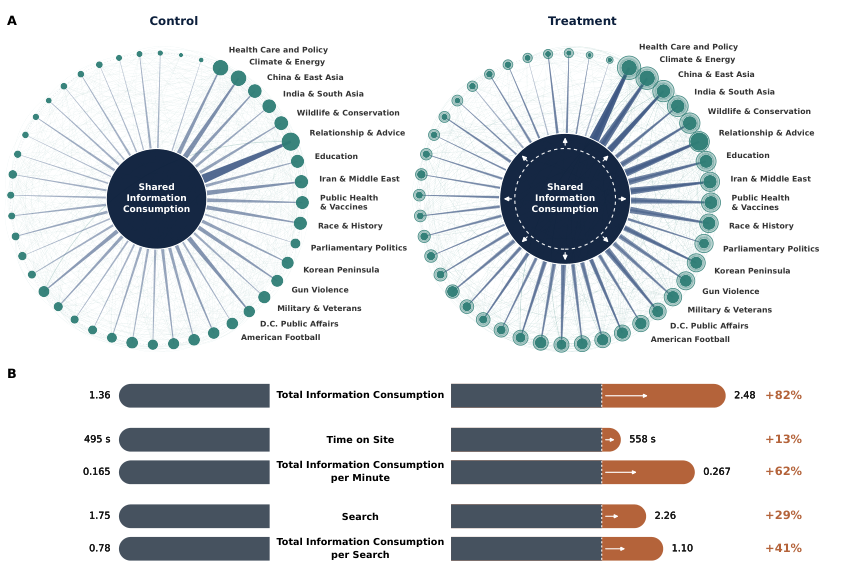
Figure from the paper, arXiv:2609.38946, by its authors. Caption as written: Figure 1: (A) RAG search increases consumption of both shared and non-core information. Node area shows the amount of information consumed per reader, and edges connect topics consumed following the same search (Supplementary material, section S27). (B) RAG search increases searches per reader and total information consumption per search (search efficiency). Total information consumption per reader increases more than time on site per reader, so total information consumption per minute (consumption efficiency) also increases.
Look at the reduction in topic concentration and the simultaneous shift toward less-popular topics at individual and aggregate levels.
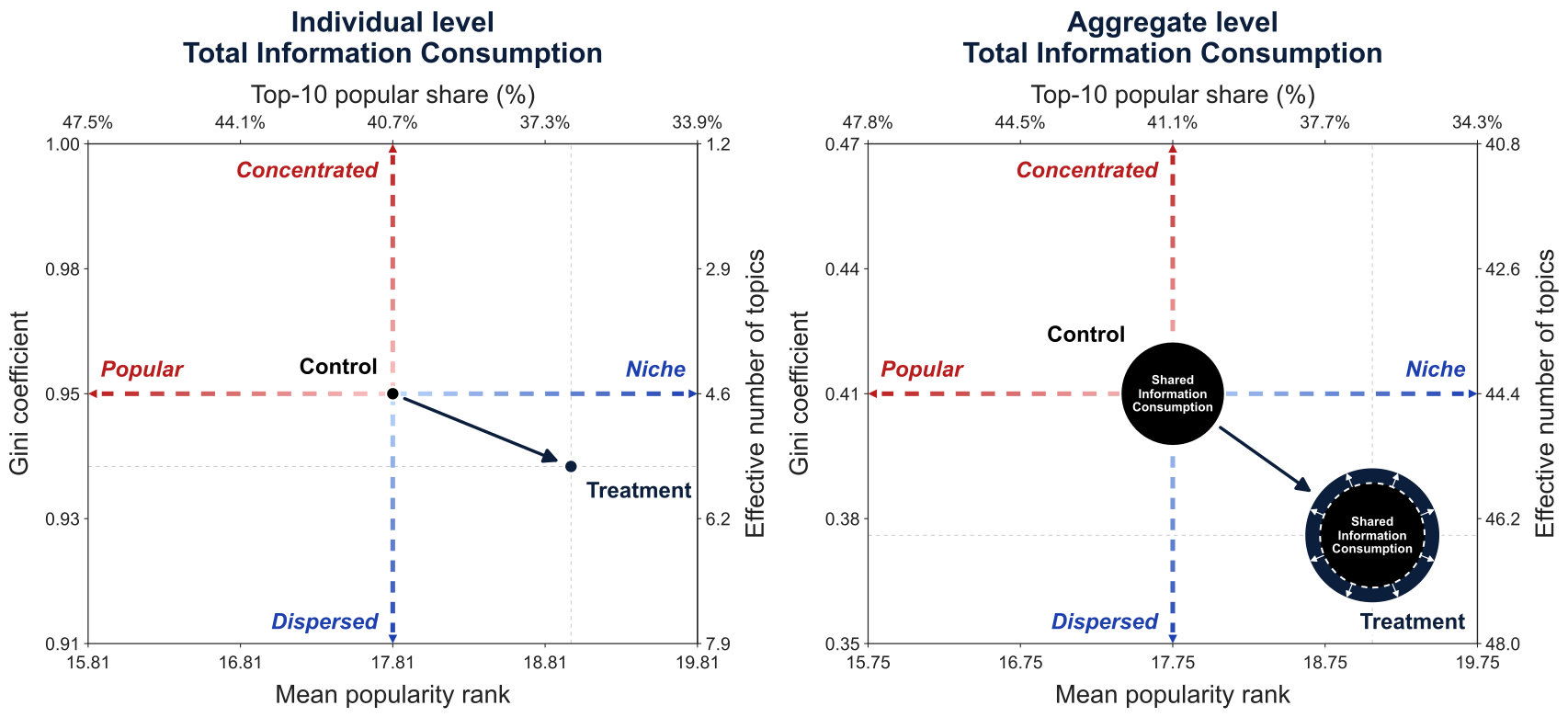
Figure from the paper, arXiv:2609.38946, by its authors. Caption as written: Figure 2: At both the individual and aggregate levels, RAG search disperses total information consumption toward less-popular topics. In the aggregate panel, dot positions show the concentration and popularity of each group’s overall consumption. Dot area is proportional to shared information consumption averaged over all readers in each group, which is higher in Treatment than in Control.
What the authors say it means
- Generative search answers do not inevitably isolate readers into separated informational bubbles.
- Direct answer boxes can preserve a shared factual baseline across a diverse readership without cannibalizing total article exposure.
- Citing specific source links in generative answers encourages discovery of niche content that traditional ranked lists leave unclicked.
What to do with it
- Include clear source links directly inside AI-generated summaries. Supported by: Cited articles contributed directly to shifting reader attention toward less-popular topics.
- Design generative search interfaces to support quick follow-up queries. Supported by: More frequent searching balanced lower article consumption per search to raise overall article reads.
- Optimize content to serve as concise factual references for widely read core events. Supported by: AI answers accounted for most of the increase in shared information consumption across the readership.
Caveat. The study was conducted within a single mainstream news publication and did not evaluate external search engines that index multiple publishers.
In short
This field experiment demonstrates that generative AI search can increase the shared information readers consume while broadening overall topical reach. Rather than narrowing attention, synthesized answers with citations help users discover less-popular articles and conduct more follow-up searches. Publishers and search platforms can use these mechanics to maintain common social context without trapping users in closed informational silos.
Written from the paper's own text and checked by a person before publishing. Quoted passages are verbatim; numbers are the authors' own. For the method and full results, read the paper.